Every group I take out ends up holding a square of the same chocolate at some point in the day. I don’t tell them why, not at first. I want them to taste it before they hear the story. The story is the point, and this bar carries the biggest one I know.
I wrote recently that sustainability hasn’t died, it has just gone quiet. Companies still do the work, mostly, but they have learned to whisper it, because saying it out loud has become commercially awkward. Greenhushing, they call it now. Do the good thing, keep your mouth shut.
There is one company in this city that never got the memo. It does the opposite of whispering. It prints its worst numbers on the wrapper and dares you to keep eating. It’s a chocolate bar, and it’s the clearest argument I know for why the quiet approach has it backwards.
I like my guests to taste the real things this country makes. The cheese from a family farm rather than the rubbery souvenir-shop version, a handful of pepernoten in season, the food that carries a story instead of a price tag. Tony’s Chocolonely is the one I save for the conversation I love most, the same one I have about water, and windmills, and a country that keeps turning up at the front of these arguments.
How a journalist tried to get himself arrested
In 2003 a Dutch reporter named Teun van de Keuken was making a consumer programme about food and stumbled into something that would not let him go. The world’s largest chocolate companies were buying cocoa from West African farms that ran on illegal child labour, and in the worst cases on outright slavery. He asked the big companies about it. They ignored him.
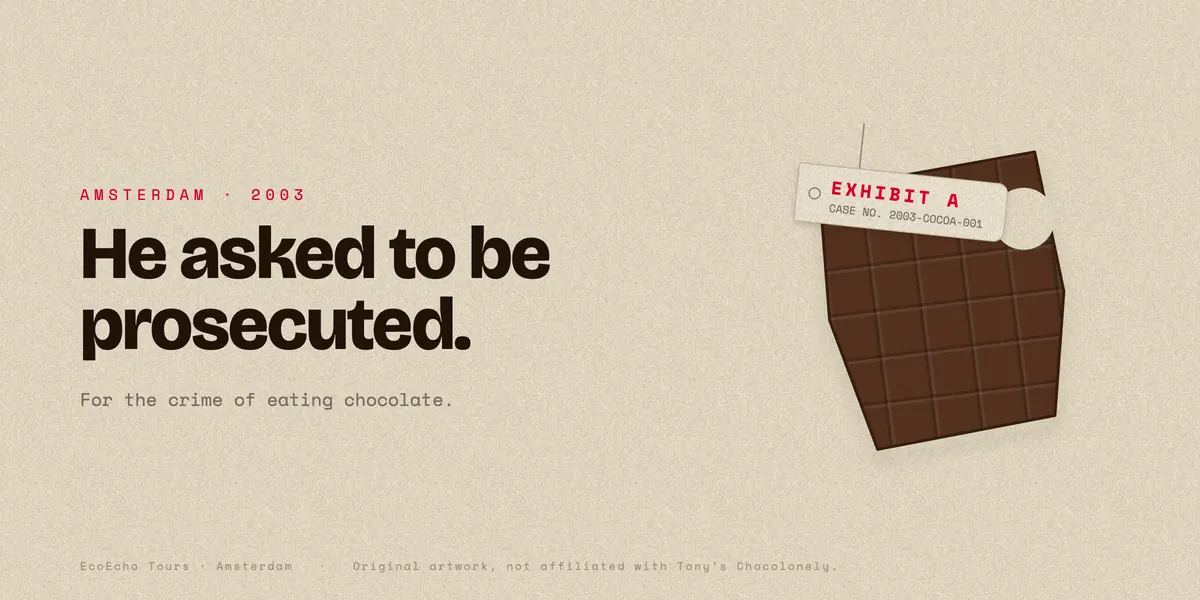
So he turned the law on himself. His argument was simple and provocative: if you knowingly consume the product of a crime, you share in the guilt. Van de Keuken ate several bars on camera and then turned himself in to the authorities, asking to be prosecuted as a chocolate criminal. It was a trap. If a court convicted him, then eating ordinary chocolate was a crime, and every consumer and every corporation was guilty next to him. The case dragged on for years. As late as 2007 he was still asking an Amsterdam court to find him guilty. They never obliged him.
He had made his point, though, and somewhere in the middle of losing he decided that arguing with the industry was not enough. He would build a company that proved the argument instead. Tony’s Chocolonely launched in 2005. Even the name is a confession of how it felt. Lonely, standing against an entire industry while insisting there was a better way.
Why a Tony’s bar is broken into unequal pieces
Most products are designed to flatter you. This one is designed to unsettle you, gently, in the half-second before the first bite.
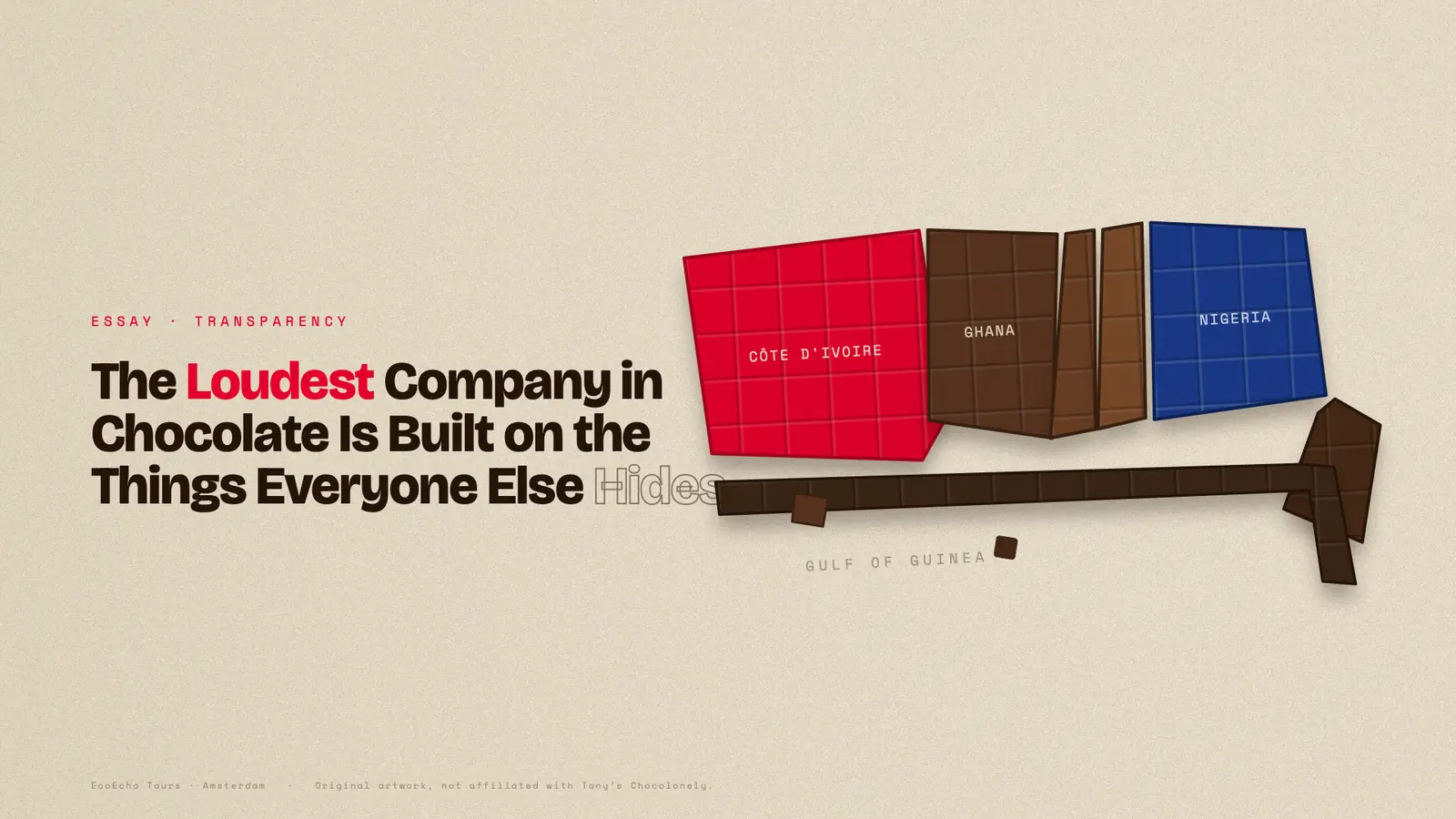
Snap a Tony’s bar and the pieces come out wrong. Some huge, some tiny, none matching, as if the mould had been made by someone who had never seen a chocolate bar. It’s entirely deliberate. The uneven pieces are a picture of how the cocoa trade actually divides its money. Enormous chunks for the companies at the top, crumbs for the farmers who grow the beans. The shapes even trace the coastline of the Gulf of Guinea and its cocoa nations. A normal wrapper stops speaking the moment you tear it open. This one keeps making its case the whole time it’s in your mouth.
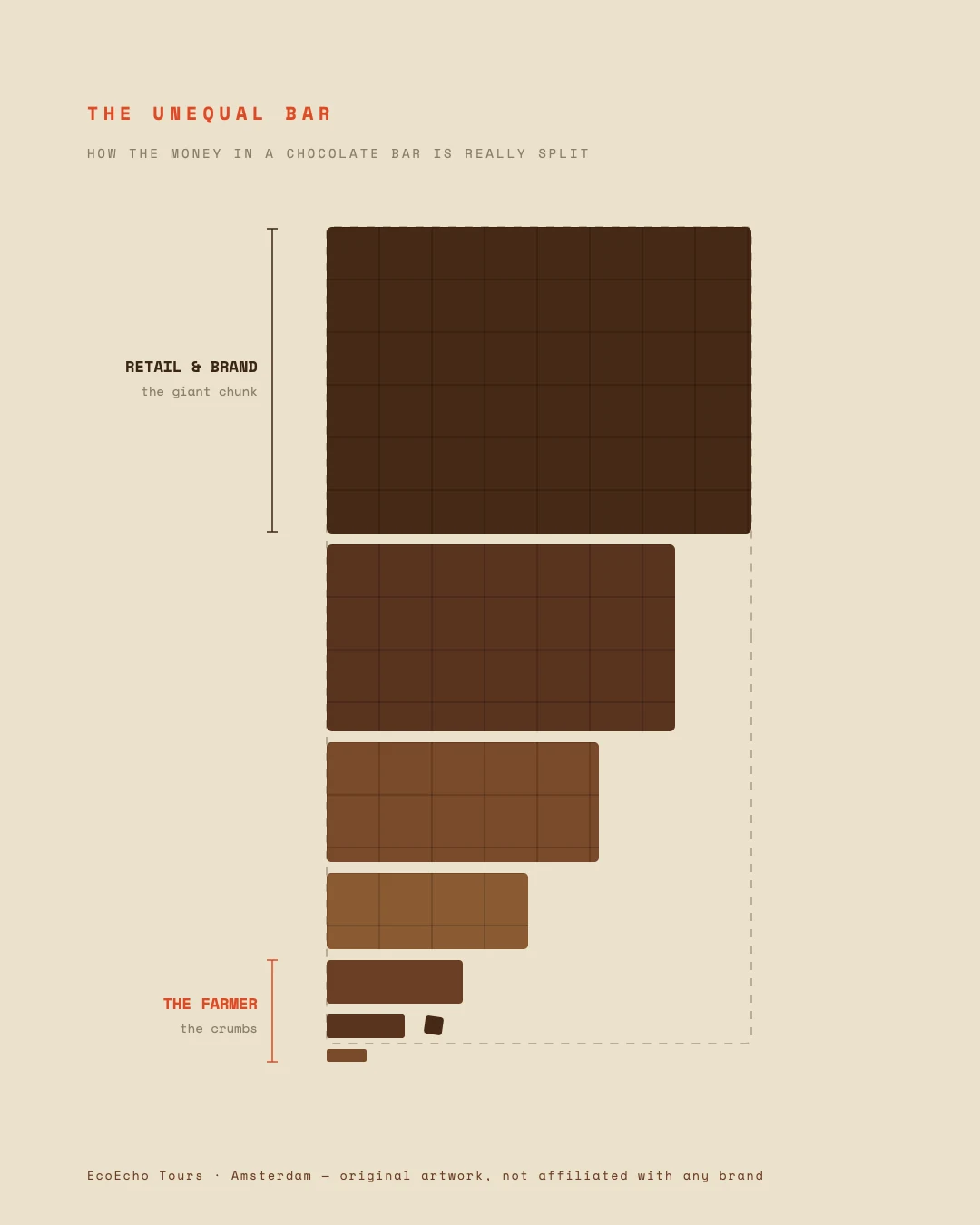
That thread runs through everything Tony’s does. The design is honest before it is pretty. Honesty here isn’t a slogan. It’s the method.
This is the bar I put in my guests’ hands. It’s also the story we tell in full on our private sustainable Amsterdam walking tour, usually somewhere between a canal and a cheese counter.
Why they publish what everyone else buries
This connects straight back to the quiet I started with.
A company built on a slave-free promise has every incentive to declare victory and move on. Tony’s does the reverse. It traces every bean back to the farm it came from, through a system it built itself, and because it actually looks, it finds child labour inside its own supply chain. Then it publishes what it finds, season after season, rather than quietly dropping it.
And the looking works. At its longest-standing partner cooperatives, child-labour prevalence sits below 5 percent, against an industry benchmark of 46.7 percent. Both figures come from Tony’s own 2024/25 FAIR report, with the 46.7 percent drawn from NORC research at the University of Chicago. The brand whose entire value rests on being clean is the one telling you where it’s still dirty. Pretending the problem is solved is exactly how the problem survives. Tony’s decided its image was worth less than the truth, and that telling the truth was the only thing that would actually move anything.
“Collaborate on cocoa, compete on chocolate”
The honesty would be a nice moral footnote if it stayed small. It hasn’t. This is where the charming Dutch oddity becomes something harder to dismiss.
Their sourcing rests on five principles, and Tony’s is clear they only work when you apply all five together, not as a ranked list:
- Trace every bean back to the farm it came from, with no anonymous heaps.
- Pay a higher price, a Fairtrade premium plus an extra living-income premium.
- Support strong farmers, organised into professional cooperatives.
- Go for the long term, with commitments of at least five years.
- Improve quality and productivity, which eases the pressure to clear forest for more land.
Then comes the genuinely radical move. They took the whole system, the technology, the standards, all of it, and opened it up to their competitors. They call it Tony’s Open Chain, under a line that ought to be taught in business schools. Collaborate on cocoa, compete on chocolate.
The point was never to be the one good bar on the shelf. It was to remove the industry’s favourite excuse. When the giants say full supply-chain control is impossible at scale, Tony’s hands them the working platform and says, here, we built it, your turn. Around twenty companies, Tony’s calls them Mission Allies, now source through it, including household-name supermarkets.
And the numbers are the part the cynics have to answer for. In its 2024/25 financial year, revenue rose around 20 percent to €240 million, and the United States overtook the Netherlands as its single biggest market, almost all of it built with next to no traditional advertising. The loud, honest company that publishes its own problems is the one winning.
That isn’t in spite of the mission. It’s the mission doing the marketing.
There is no social justice on a broken planet
That idea runs right through Tony’s, and it’s why the company belongs in the same conversation as windmills and water management. Tony’s refuses to split the social from the environmental, because in cocoa they are one problem. The farmer pushed into poverty is the same farmer pushed into clearing forest, and the warming climate comes for his harvest first.
The backdrop is brutal. Côte d’Ivoire has lost around 90 percent of its forest since independence in 1960, and Ghana well over half, with cocoa behind a large share of that loss. Against that, Tony’s satellite-maps tens of thousands of farms and verifies 99.99 percent of its chain as deforestation-free. Only two of the 42,538 farms it monitors show any deforestation, which is why its cocoa carries far lower emissions than the cocoa grown right beside it.
It also funds farmers to plant shade trees. And here’s the detail I keep coming back to. They keep that planting deliberately simple, turning down a more elaborate, more photogenic system, because complexity would demand more hands in the fields, and those hands could end up being children’s. They won’t fix the forest by breaking the family. I have not seen another company reason it through that far.
You don’t have to take their word for it, either. On the independent Chocolate Scorecard, run by Be Slavery Free, Tony’s came first among large companies in 2025. In the 2026 edition it placed second overall behind HALBA, while ranking first for living income and taking the Scorecard’s Gender Award. It’s a B Corp scoring 125, against a median of around 51 and a passing bar of 80.
Locking the mission so no future owner can sell it
There’s one more thing, and it’s the part that, against all expectation, moves me.
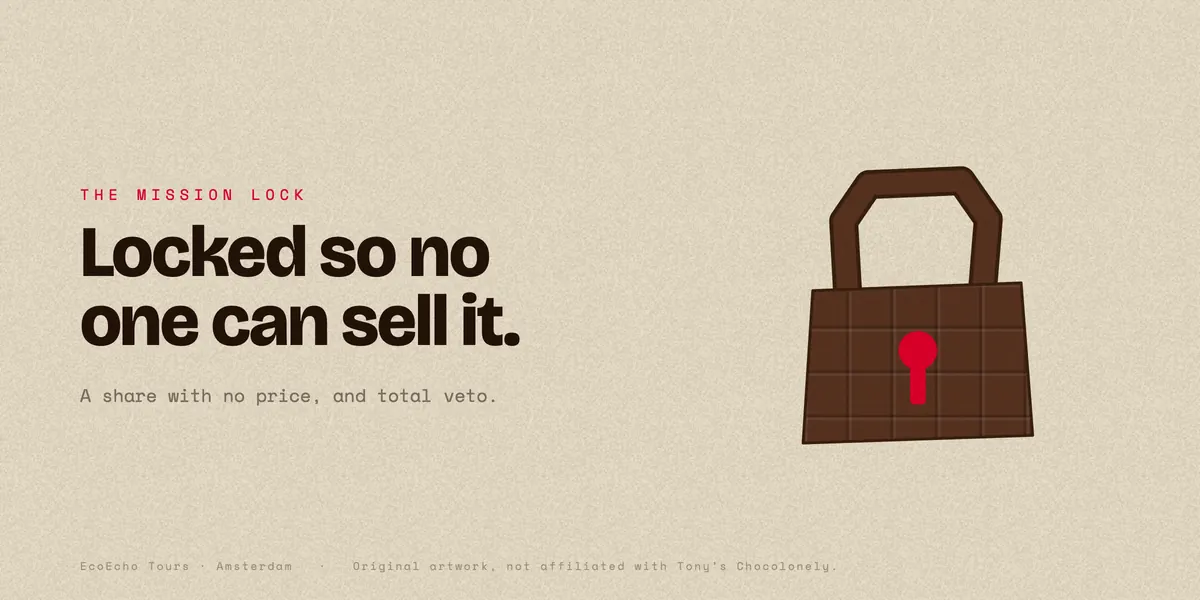
The fear with every mission-led company is the same. It grows, it gets bought, the founders cash out, and the new owners quietly book the conscience as a cost and cut it. Tony’s looked that future in the eye and built against it. They created a separate legal structure, the Mission Lock. It holds a golden share with no financial value but real power. The mission and the five principles cannot be changed without its consent, no matter who owns the company. Three independent guardians watch over it, and if leadership ever drifts they can investigate, publish their concerns in Tony’s own annual report and in national newspapers, and ultimately take the matter to arbitration.
They put their purpose somewhere the market cannot reach it. They made it harder to abandon the mission than to keep it. I can’t think of a cleaner answer to the cynic who says ethics is just branding that lasts until the next acquisition.
So when the experts tell you to go quiet, to do the good thing and whisper it, here is the company that did the opposite, printed its sins on the wrapper, and grew faster for it. The whisperers have it backwards. The proof is sitting on the shelf, broken into uneven pieces.
Why a square of it rides along with us
I’m not in the chocolate business. But EcoEcho rests on the same single idea that holds all of this together. That doing things honestly, in a way that respects the people and the places involved, is not a tax you pay against good business. It is the better business, and Tony’s is the proof at a scale I’ll never reach. It’s not a company I copy so much as an example I keep coming back to, in my own quiet way, with every group I take out.
So the square I hand over is never just a snack. It’s the shortest version of the argument I love. And to my taste it’s also simply the best chocolate I’ve eaten, though I’d think all of this even if it weren’t. A country that pulled itself out of the sea was never going to make ordinary chocolate. It made one that argues with you.
That’s worth a detour, and it’s worth a taste.
Where this story turns into a tour
Honestly, this is a story that lands differently when you’re standing in front of the place it started, rather than reading it off a wrapper. That’s the kind of thing my tours are made of: the real Amsterdam, not the tidy postcard, small groups, no script, and the odd square of chocolate to make a point land. EcoEcho runs small-group and private sustainable tours of Amsterdam and the Dutch countryside, built on the same idea behind this bar.
On a private day built around what you are curious about, when the timing works and there’s no queue, we can stop in and make our own chocolate bar. You choose what goes in, watch it set, and leave with something you made and a story behind it. When it lines up, it’s one of the nicest hours of the tour.
▸ Send me your dates and I’ll hold a spot. Small groups, the chocolate-and-sustainability route, rated 5.0 on Google and Tripadvisor, 4.97 on GetYourGuide.
Or see the tours first, or ask about a private day.
Antonis is the founder and lead guide of EcoEcho Tours, running small-group, private, and educational tours across Amsterdam and the Dutch countryside.
EcoEcho Tours is not affiliated with, sponsored by, or endorsed by Tony’s Chocolonely. All trademarks belong to their respective owners. Figures are drawn from Tony’s FY2024/25 FAIR reporting, the independent Chocolate Scorecard (Be Slavery Free), and B Lab, and were accurate at the time of writing (June 2026).
Common questions
Where is Tony’s Chocolonely in Amsterdam?
Tony’s Chocolonely’s flagship Super Store sits on the corner of the historic Beurs van Berlage building, at Oudebrugsteeg 15 near Dam Square, with a make-your-own-bar experience inside.
Can you make your own chocolate bar at Tony’s in Amsterdam?
Yes. At the Super Store you choose your chocolate and ingredients, design the wrapper, and collect the finished bar a little later. Check the current price and timings on Tony’s own site before you go. On EcoEcho’s private tours we can include this when timing and queues allow.
Is Tony’s Chocolonely really slave-free?
Tony’s works toward a fully slave-free supply chain by tracing every bean and actively monitoring for child labour, and it publishes the cases it finds rather than hiding them. It came first among large chocolate companies in the 2025 Chocolate Scorecard and has stayed among the very top since.
Does EcoEcho offer a chocolate or food tour in Amsterdam?
Our small-group and private sustainable tours of Amsterdam weave in local food and the Tony’s story. Private tours can include the make-your-own-bar experience when timing allows.